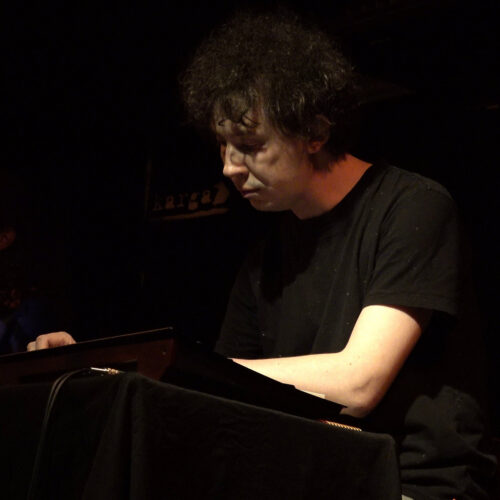
Jashiin is a composer based in Istanbul, Turkey who has been consistently releasing music over the last twenty years.
I caught up with Jashiin to talk about their early musical experiences, how they started creating music and the making of their new E.P. “Dedications”.
CMM-What was the first music that really made an impact on you as a kid and what artists or bands did you enjoy the most?
Jashiin-Neither my family nor my friends were particularly interested in music, so I never listened to anything much as a kid. My first proper experience of music came very late and it was through the demoscene and tracker music. Especially Finnish tracker music – people like Jonne “Purple Motion” Valtonen, Aleksi “Heatbeat” Eeben, Sami “Groo” Järvinen, Lassi “Dune” Nikko. Tracker music was open source so I could study their pieces and reverse-engineer them, and that’s how I was inspired to learn. I was 14.
It was also through tracker music composers that I started listening to records, because I’d ask them about their favorites, and also they’d credit their sample sources (which would normally be published CDs and such). I listened to everything – Beethoven, Enya, Radiohead, Coltrane, Masterboy, Mylene Farmer, Whodini. My biggest influences though were Vangelis and Aphex Twin, because their music used so many new sounds and was so varied. Vangelis did weird conceptual jazz records which still sound strange to me, soundtracks which made me experience feelings I had no names for, gorgeous electric piano pieces which sounded like they came from outside of time and existed always. And, unbelievably, Aphex Twin had a similarly wide range but was somehow exploring a totally different territory. It was incredible to listen to their stuff, to look for rare records and bootlegs, I never forgot that feeling – of music being an infinite universe of wonder and mystery.
CMM-When did you first start creating your own music?
Jashiin-I was 14 when I made my first pieces of tracker music. I didn’t know anything about music, so it took me a while to even understand that drums could be put in regular patterns to produce a beat. I was 18 when I got my first keyboard, a kind of toy I couldn’t do much with, but I tried my best. I was 20 when I got my first real instrument, a Kawai K5000S, but I was too inexperienced for it. I only recently started using it on records like “Bitterness Is Best Declined as a Companion” (from 2023). And I was 21 when I taught myself musical notation and started making pieces for performers who use acoustic instruments.
CMM-You recently released an E.P. called “Dedications”. What was the inspiration for the compositions and what was the recording process like? Any particular gear or instruments you used during the sessions that helped inspire you?
Jashiin-I did a piano improv record last year called “State of Play”, political music and based on a percussive approach to playing the piano. The technique I used had a lot to do with an Iranian instrument called santur, which I really love. Lots of tremolo passages, microphones set up very close to the strings to capture that metallic ring, octaves and fifths. It’d go from climax to relaxation to climax again, I would try to build these castles of octaves and fifths, playing with the harmonic series, and then have them collapse slowly. It was a very intense record done at a very intense time – countries around us bombed, thousands of people becoming refugees, the economy tanking. I came to think of “State of Play” as a record about fleeting beauty. About to be engulfed by the darkness, but existing at least for a short while.
I was able to make “State of Play” thanks to my friend Zeynep who offered the use of her piano, her recording equipment, and her home. This year, there was a brief opportunity to record something at her place again, but I only had a very limited amount of time. The state of the world was even worse than last year, and my own personal circumstances took a bad turn. I didn’t want to repeat myself, so I had to think of another way of playing the same piano, and also another way of dealing with horrible circumstances. I had no idea what I could possibly do. When the recording day came, it was my first day off in many weeks. I wanted to treat it as a tiny vacation. I took my favorite books with me, spent some time lounging around in the living room, played the piano for a bit, had coffee in the garden. Then at some point, I improvised a short piece with nothing but a simple scale in it, repeated several times. The strings kept resonating in this beautiful way, the quietest notes had a harp-like sound to them, I’m not sure what it was exactly, but I felt at peace for the first time in months. So this was what I ended up doing: two 20-minute pieces which repeat the same thing over, and over, and over again, gently ebbing and flowing, weaving a small world of just a few notes and staying there, basking in the sunlight of a small sun.
CMM-If you could score any film director’s movie who would it be and what would the film be about?
Jashiin-Jordan Peele. I loved “Get Out” and especially “Us”, and I think I could do a mean horror movie soundtrack. Because I also do electronic music and can do all kinds of strange, menacing, animal-like sounds. It could be some sort of cosmic horror type plot. I can make dark pads laced with death rattles, piercing cries of unknowable birds of prey, the works. I can do a Carpenter arpeggio too if that’s what they’d want. And if I get to hang out with Lupita Nyong’o, I can do the music for free Jordan!
CMM-What do you have coming up next?
Jashiin-There’s a lot coming up next, actually!
Me and Zeynep have a synth duo project called “Minute Sea” and we’ll be releasing our first album and single in a few days.
I’ll be releasing an album version of a recent electronics & field recordings piece I played live within a month or so.
Later this year I’ll also be releasing two other electronic albums, one of raw, unedited, unmastered tiny pieces made with the barest possible means and called “pieces with missing parts”. And another, “Trumpet Tunes from Balıkesir”, which is a kind of fake folk music record with drums, DIY trumpet recordings, and processing inspired by old dub records.
I’m playing live in Istanbul every now and again, both solo and in ensembles. Because of my visa situation (I’m essentially a refugee) I can’t really travel abroad for now, but my notated music is sometimes played by other people. Huw Morgan’s playing my organ piece “Overflow” on the 25th of April, for example – you can check out his page here.