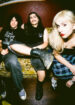
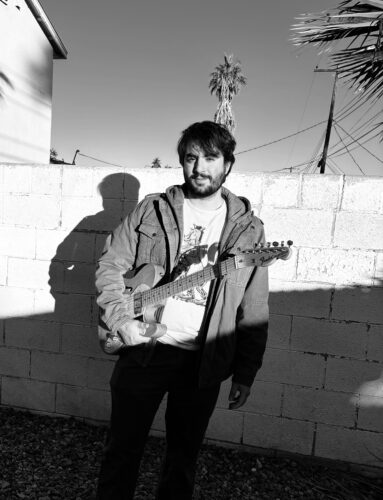
Loveletting is an emo/math rock band from Las Vegas, Nevada led by singer/songwriter/guitarist Patrick Tarzi.
I caught up with Patrick to talk about his early musical experiences, how he started playing music and the making of his latest record “Arcade Photobooth”.
CMM-What was the first music that really made an impact on you as a kid and what artists or bands did you enjoy the most?
Patrick-First, thank you so much for taking the time to listen to Arcade Photobooth and do this interview with me.
I think when you’re a kid sometimes it’s just whatever cool thing gets shared with you first. For me, my uncle gave me a Metallica …And Justice for All CD when I was 8 years-old that left a big impact on me. I know, how cliché, my first CD wasn’t Cap’n Jazz or something cool. But that Metallica record resonated with me with the slick guitar riffs/solos and political, anti- establishment lyrics. By the time I was 13 years-old, I learned to play almost all the guitar riffs off that album since I had not much else to do.
From there I graduated into playing a lot of classic death metal like Entombed. I was in a few tiny death metal bands in high school and played some local venues like Yayo Tacos (RIP).
By the time I was a late teen, I discovered old school emo music, starting out with American Football, which for some reason was getting shared a lot on the internet. This led to an obsession with both Kinsella brothers’ music. I just came back from Japan where I found a rare Make Believe record, so you know I am still bumping Tim Kinsella! However, above all else, my favorite record of all time that left a massive impact on me was undoubtedly Mineral – “End Serenading”.
I have it tattooed on my right arm, for one. You can probably hear a lot of lyrical influence of Chris Simpson on different parts of “Arcade Photobooth”.
The way End Serenading mixes complex, spindly clean guitar harmonies with heartfelt poetry that both invokes imagery and introspection on faith really resonates with me. The struggle with one’s faith in the face of life’s adversity really made an impact on me. Later on I got pretty into Japanese emo and math rock bands.
CMM-When did you first start creating your own music?
Patrick-I first started making metal and classical music when I was 13 years-old. I started off as a classical composer as a teenager, and started making soundtracks for small video games/mods. As far as “emo/math rock” music goes, the first loveletting demo I recorded was in 2017.
The first idea I had was to combine emo with crescendo-type post-rock that I was really into at the time. So I teamed up with my drummer friend Damien and we recorded an amateur demo of the idea.
It wasn’t particularly great. I think I released it as a SoundCloud demo in 2020 along with several other loveletting demos that no one listened to C’ Est la vie!
It was an experimental start to the idea that became loveletting in 2026.
CMM-Your new record called “Arcade Photobooth” is fantastic. What was the writing and recording process for those tracks like? Any particular gear or instruments you used during the recording sessions that helped inspire you?
Patrick-Thank you very much for the kind words. “Arcade Photobooth” took an obscenely long time with many changes throughout.
It took me around 5 years from start to completion. Writing I started writing the album during the COVID lockdown. I set out to write a full length album that would be more of one complete work of art, meaning that I wanted each song to fit into a larger concept, as in all the songs working together. The guitar parts were mostly written with demos recorded by June 2021.
The real concepts for the album started much sooner, back when I was starting to write emo/math rock several years prior, collecting cool riffs and such. The COVID lockdown and the year after that simply created an opportunity to start mapping things out.
The whole guitar concept for the album was built on counterpoint, the classical concept of two different melodies playing with each other to create one melody, while still keeping their own individuality. I started off writing music as a fan of Bach, who used counterpoint extensively. Rather than writing melodies for one guitar, I would supplement and chop-up my melodies by having two guitars playing together.
This gives you access to interesting harmonies/intervals. The layers of guitar melodies kind of create one beautiful musical lasagna. As far as what inspired me writing the guitar parts, aside from what I was just naturally creating out of my own emotions and experiences, it was a mixture of 90’s emo bands and a lot of Asian emo/math rock, which I think is what really resonates with people. It’s like this intricate Asian math rock/post-rock instrumental record but with clearly American emo vocals and themes.
The biggest Japanese and Chinese math rock influences on the guitar writing were probably toe, a picture of her, Hyakkei, Chinese Football, and Daijiro Nakagawa’s projects like Uchu Conbini. Daijiro is simply a genius guitar player/composer.
If you listen closely to Arcade Photobooth, you will hear a lot of strange mathy odd time signatures and polyrhythms throughout, but they’re pretty subtle. For example, the first part of “Arcade Photobooth” is written in 14 count.
What’s interesting to me personally is that almost all the guitar parts, the main “meat” of the songwriting, came to me over a fairly short period of time from 2020-2021, I would just spend the weekends dishing out these ideas. Something unique to that period of my life spurred me to write the album, and I can’t really pin it down. From a lyric writing perspective, the album was first and foremost an earnest expression of my own emotions and introspection; most of all the songs encapsulate a message and feeling of hope for the future in spite of life’s adversities. It’s not a doom and gloom emo album.
There’s a transient, unfinished, feeling of grappling with doubting one’s faith, and ends with a sense of letting go, at least for me. Sometimes you may hear lyrics that sound like they were written about a relationship, where I may have actually been writing about challenges with faith or believing in God; I leave that to listeners to decipher.
There isn’t a clear answer there in the album; I think the beauty of emo music is simply the journey of not knowing, not having answers. I actually really ended up disliking my vocals on the album, despite trying my hardest, but they’re quite authentic, so I kept them. Recording For recording guitars, I used Fender Telecasters with single coils, and sometimes I used this crazy Fender Telecaster American Vintage Thinline ‘72 with humbuckers. Let’s just say I am a total fanatic for telecasters, I have three at this point. The sound of two telecasters in opening tunings playing together definitely inspired me.
I recorded parts straight into a Fender tube amp and close mic’d the speaker with a Sennheiser e906. Sometimes I would reamp a DI signal into the amp.
The bass guitar parts also incorporated some degree of counterpoint, finding new ways to change the sound of the song by shifting a root note unexpectedly at times. Room tone was a huge obsession of mine during recording. For the guitars, I used a large diaphragm AudioTechnica condenser microphone placed at the other end of the room to capture the natural room sound. For the drum room mic we used a Sontronics STC-2.
I really wanted a drum sound that was influenced by the Japanese bands “toe” and “a picture of her,” with lots of linear drumming and ghost snare hits, along with a natural room tone and high tuned snare. I was pretty interested in how Steve Albini recorded records like American Don, and he loved room mics.
I really did not want the album to sound too perfect, polished, or modern – I wanted it to have the flavor of 90s emo records, foregoing a lot of compression and post- production effects in general. The magazine Fecking Bahamas was pretty spot on in their review, where they described the album as sounding like it could have come out in the 2000s. I also really liked the natural sounding production of The Cabs’ first record, The First Incident, and sought to incorporate elements of that record.
CMM-If you could score any film directors movie who would it be and what would the film be about?
Patrick-It would definitely be anything by Kyoshi Kurosawa. I just love the oppressive, depressing, yet dreamy atmosphere of his movies! Maybe a little on the spooky side, if that’s your thing.
CMM-What do you have coming up next?
Right now, the focus is on live shows. Since I finished recording the album, loveletting evolved and became a full band with some awesome people I met in town: Elmer, Diego, Nebeu, and Raymond. We have one show coming up on June 6, and one on June 29 in Las Vegas. After that, the goal is to set up some shows in Los Angeles and Flagstaff, Arizona. I also have a few ideas I’ve been writing for the next record, but that will be a little ways away and involves some internal questions of what “sound” loveletting should lean into for the next record, whether that’s more “emo” or more math rock, or something else. The first guitar parts for “Arcade Photobooth” were written 5 years ago, and I’ve improved since then both in playing and writing, which is
exciting to me.